
Rooted in an ancient posture · Confirmed by modern science
Sit less. Squat right. Let your body finish the job.
A footstool that restores the natural squatting angle on any western toilet — the posture the human body evolved to use, and the one colorectal research keeps circling back to.
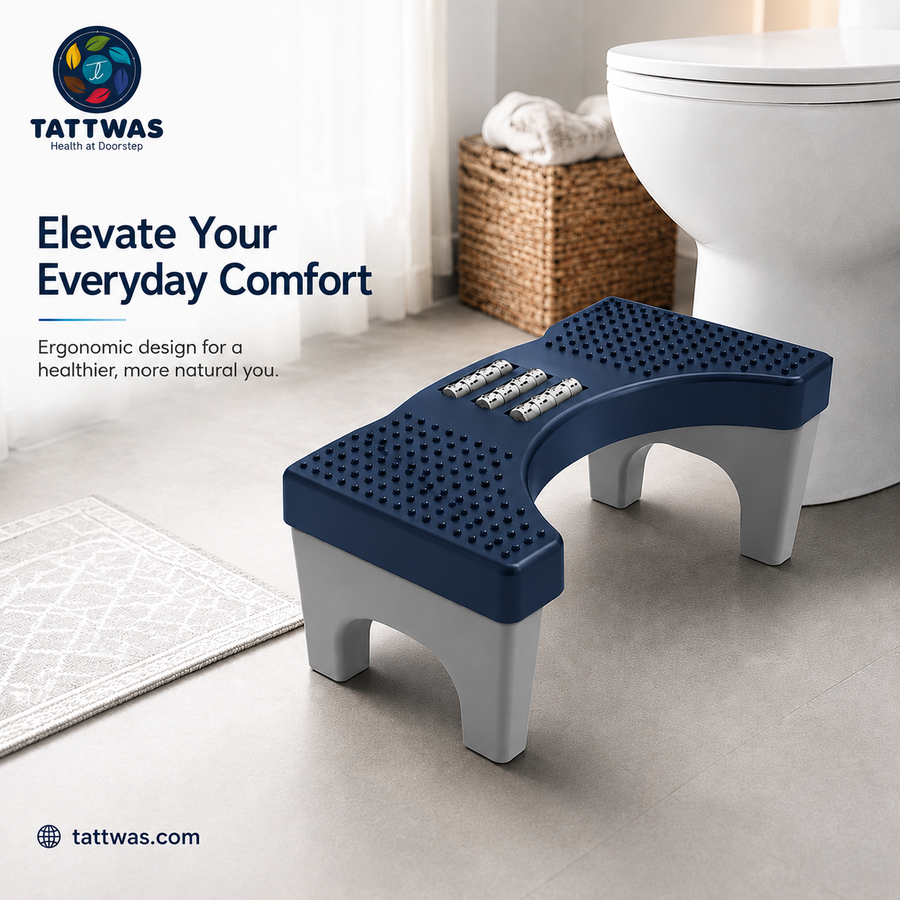
Ergonomic Arched Footstool · Non-Slip Textured Surface · Reflexology Foot Bar · Fits Most Western Toilets
Rs. 499.00
Add to cart
2.5×Faster average time to satisfactory emptying
~137°Anorectal angle reached vs. ~100° sitting
9Peer-reviewed studies cited on this page
Key benefits · why a footstool
A body built for the ground, living on a pedestal.
The pedestal toilet is barely two centuries old. It holds the hips, knees and ankles at roughly 90 degrees — comfortable for almost everything the body does, except this.
A band of muscle called the puborectalis wraps the lower rectum like a sling and stays partly contracted at rest, creating a deliberate bend that helps you stay continent the rest of the day. Sitting upright doesn't fully release that sling, so most people end up pushing against the bend rather than simply opening it. Anatomists have described this since the 1960s as a hose bent sharply at the tap: contents can still pass, but only with extra pressure behind them.
Squatting never disappeared. It remains the everyday standard across large parts of Asia, Africa and the Middle East. In the yogic tradition the posture has a name — Malasana, or garland pose — long practised as a hip-opener and, in Ayurvedic thinking, linked to healthy elimination. Malasana's place in yoga and Ayurveda is a matter of tradition and lived experience, and we present it honestly as that. The clinical claims below come from a separate body of peer-reviewed research, and we keep the two clearly apart.
For when a full squat isn't an option
📐
Opens the angle, without the floor squat
Knees rise above the hips, bringing the anorectal angle from roughly 90–100° to around 115–120°.
⏱️
Less time. Less pushing.
In the most-cited study in this field, squatting cut average time to satisfactory emptying to under half that of standard sitting.
💆
Reflexology while you sit
Three ridged rollers let you gently work the soles of your feet.
🪑
Steady on any bathroom floor
Four wide-set legs and a dimpled non-slip top hold their footing on tile, stone or vinyl.
📖
Evidence that shows its own counter-evidence
We publish the one rigorous trial that did not confirm the effect.
👥
Who it's for
Older adults, anyone recovering from a knee or hip procedure, people with arthritis, and women in later pregnancy — exactly the group a full squat is hardest for.
Three postures. One mechanical difference.
| Posture | Anorectal angle | Physical demand | Best for |
|---|---|---|---|
| Western toilet, sitting | ~90–100° | Lowest demand | Baseline — not recommended as the only option |
| Western toilet + Tattwas stool | ~115–120° | Low demand | Most people, most days |
| Indian toilet, full Malasana | ~125–137° | Highest — needs full joint mobility | Those who can comfortably squat |
Benefits backed by research
Measured in seconds, not guesswork.
28 healthy volunteers, ages 17–66, timed six bowel movements in each of three positions. The differences were significant in every subject.

Fig. 1 — Posture and the anorectal angle. Schematic views of the lower digestive tract in each posture — renderings of published angle measurements, not photographs or a medical scan. The sharper the bend, the more pressure needed to pass it. Malasana opens the angle most, but asks for mobility not everyone has; the footstool is the accessible middle path. Anorectal-angle ranges follow Sakakibara et al. (2010), LUTS — a videofluoroscopy study measuring the angle directly under X-ray at three hip-flexion levels.
| Position | Avg. time to satisfactory emptying | Relative effort |
|---|---|---|
| Sitting — standard toilet (41–42 cm) | 130 sec | Highest straining |
| Sitting — lower toilet (31–32 cm) | 114 sec | Reduced, still elevated |
| Squatting | 51 sec | Lowest (P < 0.0001) |
Sikirov D. (2003), Digestive Diseases and Sciences, 48(7):1201–1205.
Three steps. A few sensible checks.
1
Place it
Slide the stool against the toilet base so the arch wraps around it — flush, without wobbling.
2
Rest your feet
Sit normally, then place both feet on the stool. Your knees should rise noticeably above your hips.
3
Lean and relax
Lean slightly forward, elbows near your knees. Let the position do the work — avoid pushing or holding your breath.
Scientific evidence
The receipts
Comparison of straining during defecation in three positions — 51 seconds squatting vs 130 seconds standard sitting
Sikirov D. (2003). Digestive Diseases and Sciences 48(7):1201–1205
Influence of body position on defecation — anorectal angle measured directly under videofluoroscopy
Sakakibara R, Tsunoyama K, Hosoi H, et al. (2010). LUTS 2:16–21
Implementation of a defecation posture modification device — improved duration, straining and completeness
Modi RM, Hinton A, Pinkhas D, et al. (2019). J. Clinical Gastroenterology
The Thinker position — forward-lean posture and defecation efficiency vs. upright sitting
Takano S, Sands DR.
The honest counterpoint — a footstool did NOT significantly aid simulated defecation in undifferentiated constipation
Trieu K, et al. (2022). Gastroenterology — randomized trial
Squatting and risk of colorectal cancer — association only, not causal
Sohrabi M, et al. (2012). Middle East J. Digestive Diseases
Etiology and pathogenesis of diverticulosis coli — hypothesis paper, not a trial
Sikirov BA. Medical Hypotheses
Bowel disorders through toilet designs: a myth or reality? — review
Bhattacharya S, et al. (2019). J. Education and Health Promotion
The anal canal and rectum — the classic description of the anorectal angle
Tagart REB. (1966). Diseases of the Colon & Rectum
Including the one that didn't confirm the effect. Sohrabi (2012) is association-level only and Sikirov's diverticulosis paper is a hypothesis paper — we label those rather than present them as proof.
Sensible checks
🩺 Check with your doctor first if…
You are managing a diagnosed bowel condition such as IBD, diverticular disease or rectal prolapse — this is a comfort aid, not a treatment. You have significant hip, knee or pelvic joint limitations. You are in late pregnancy or have balance concerns on the toilet.
✅ Good practice, every time
Let the posture do the work — avoid straining or breath-holding. Check the stool sits flat and does not rock before stepping on. See a doctor for persistent constipation, bleeding or pain.
Frequently asked questions
Will it fit my toilet?
It fits most standard western toilets; the arch curves around the pedestal base so it sits flush. Measure your toilet base if you have an unusually wide or wall-hung model.
Is this a medical device?
No. It is a wellness accessory, not intended to diagnose, treat, cure or prevent any disease.
Will it cure my constipation?
We won't claim that. Research on healthy adults shows reduced time and straining, but a 2022 trial found no significant benefit in people with undifferentiated constipation.
How long before I notice a difference?
Many people notice immediately; others take a week to adjust. Give it 7–10 days of consistent use.
I have arthritis or limited hip mobility. Is this for me?
This is arguably the group it helps most, since you stay seated with both feet supported. With significant joint limitations, check with your doctor first.
Can I use it during pregnancy?
Many women do, particularly in later trimesters. Because balance becomes a real consideration, check with your doctor first.
Is it safe on a wet bathroom floor?
The top is dimpled and non-slip and the legs are wide-set. Always check it sits flat and does not rock before stepping on.
Why publish a study that says it didn't work?
Because it exists, it is peer-reviewed, and leaving it out would make everything else here less trustworthy.
Elevate your everyday comfort.
The posture your body was built for, without leaving the seat.
Add to cartA wellness accessory, not a medical device. Not intended to diagnose, treat, cure or prevent any disease.