

A classical yogic practice · Read through clinical evidence
Rinse clear. Breathe easy. An old practice, measured honestly.
A lead-free ceramic neti pot for daily saline nasal irrigation — paired with what the clinical literature actually says, including where it's thin.
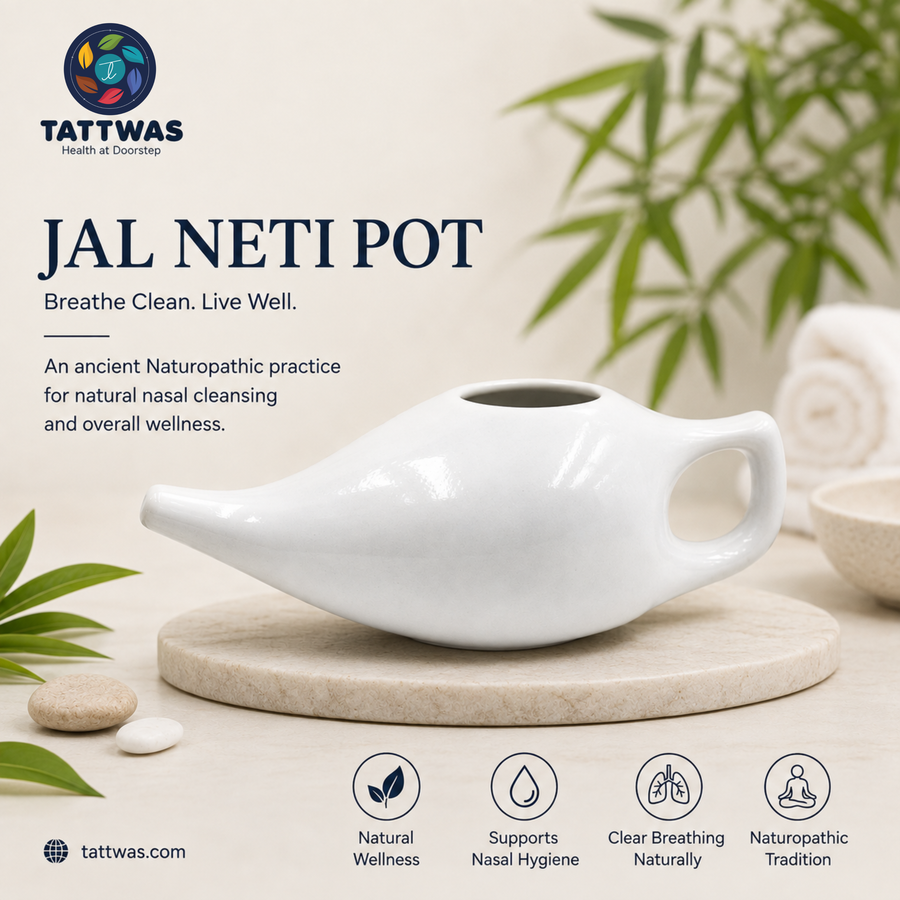
Tattwas Jala Neti Pot · Lead-free ceramic · 250 ml · dishwasher & boil safe · Lead-free · Boil safe · No claims unsourced
Rs. 599.00
Add to Basket
Read before first use
Never use tap water. Distilled, sterile, or boiled-and-cooled only — true of every neti pot ever made, whatever it’s built from. The rule, and why, is set out in full below.
747participants, 14 trials — allergic-rhinitis Cochrane review
3 reviewsindependent Cochrane systematic reviews on nasal saline
250 mla full single-pass rinse per nostril
In the box
- Ceramic neti pot, glazed inside and out
- Non-iodised salt measuring spoon
- Usage and water-safety guide
What it does — graded
Four benefits, each carrying its own evidence grade.
Flushes the nasal cavity
Saline mechanically clears mucus, pollen and dust. What the device does — not a claimed health outcome.
Mechanism · not disputedChronic sinusitis relief
Large-volume hypertonic irrigation beat placebo — on a two-trial base the review authors call hard to conclude from.
Grade · lowAdd-on for allergic rhinitis
14 trials, 747 participants, signals pointing the right way — and no follow-up past three months.
Grade · low to very lowRecommended in ENT guidelines
Major sinusitis guidelines recommend it. Guideline endorsement and trial-evidence strength are different things.
Guideline consensusWhy Jala Neti
Your nose is a filter. Nobody empties the filter.
The nasal lining traps dust, pollen, smoke and mucus before any of it reaches your lungs, and cilia sweep the load backwards to be swallowed — quietly, constantly.
That system copes until it’s overloaded — dry air, dust, pollen, a cold — and you feel it as blockage, facial pressure and mouth-breathing at night. Decongestant sprays open the airway but risk rebound congestion; saline instead washes the load out and rehydrates the lining so the cilia work again.
The trade-off is honest: a rinse treats the load, not the underlying inflammation. For allergic or infective disease it’s an adjunct, not a replacement.
Congestion and facial pressure
Rinsing clears the volume so the passage opens without a vasoconstrictor.
Seasonal allergen load
Flushing removes the trigger itself rather than muting the reaction to it.
Dry air, thick mucus
Air-conditioning and heating stall the cilia. Warm isotonic saline restores the moisture film.
Post-surgical crusting
ENT teams use irrigation routinely after sinus surgery to clear crusts.
How it works
Gravity, a level head, and an open mouth.

Neti pot filled with saline water. Water enters from the upper nostril, flows through the nasal cavity, and comes out from the lower nostril.
1
Saline enters under gravity alone
Head tilted sideways, forehead and chin roughly level. No squeezing — the column of water does the work.
2
It crosses the cavity, not the throat
Breathing through an open mouth raises the soft palate, closing off the throat.
3
Isotonic salt stops the sting
Plain water irritates the membrane osmotically. Matching body fluid lets the rinse pass without burning.
4
Debris leaves with the water
What the cilia were slowly moving is carried out in seconds, and the lining is left hydrated rather than constricted.
Benefits backed by research
Where it works, and where the evidence is thin.
Three independent Cochrane reviews — a higher bar than most of this category clears. They aren’t uniformly flattering, so we publish the grades rather than the favourable lines.
| Condition | What the review found | Grade |
|---|---|---|
| Chronic rhinosinusitis | Daily 150 ml hypertonic irrigation beat placebo; a 5 ml nebulised spray beat nothing. Only two trials met inclusion, and the authors called practice conclusions difficult. Chong LY et al., Cochrane 2016 · CD011995 | Low · very low at 6mo |
| Allergic rhinitis | 14 trials, 747 participants. May improve symptom scores, unlikely to worsen outcomes alongside medication. No follow-up past three months; most unblinded. Head K et al., Cochrane 2018 · CD012597 | Low to very low |
| Acute cold & URTI | Five trials, 544 children and 205 adults. Most outcomes no different from routine care; a limited signal in adults. Small, low quality. King D et al., Cochrane 2015 · CD006821.pub3 | Low · no firm rec. |
| Post-surgical care | No dedicated Cochrane review, but EPOS 2020 and the 2025 AAO-HNS update both place it within standard care, including post-operative recovery. EPOS 2020 · Payne SC et al., AAO-HNSF 2025 | Guideline recommendation |
| Adverse effects | Well tolerated overall, but the reviews record nosebleeds, stinging and ear pressure in a minority — usually mild, usually fixed by technique or salt. Reported in CD012597 and CD011995 | Consistently reported |
Read this correctly: a guideline recommending something and a review grading its evidence strong are different statements — which is how saline can be widely recommended while its evidence stays graded low.
The one rule that isn’t negotiable
Never use tap water. Not once.
Tap water is treated to be safe to drink, not to enter the nose — stomach acid neutralises what it carries, the nasal passage doesn’t. Both Naegleria fowleri and Acanthamoeba have caused rare but severe infections traced to nasal rinsing. Very small risk, completely avoidable.
Always safe
Distilled or sterile
Bought pre-packaged, labelled as such.
Boiled and cooled
Rolling boil 3–5 min, cooled. Keeps 24 hours in a clean closed container — the practical route in most Indian homes.
Correctly filtered
Rated NSF 53 or 58, or "absolute pore size 1 micron or smaller", or marked for cyst removal.
Never
Straight tap water
Including clean-tasting chlorinated supply — chlorine at drinking levels doesn’t reliably kill these organisms in biofilm.
Tank, well or RV water
A 2024 CDC-reported case involved an inadequately disinfected RV supply and was fatal.
Standard pitcher filters
Built for taste and hardness, not pore-size exclusion. They don’t meet the standard.
A rule about water source, not the pot — identical for ceramic, plastic, steel and copper, including ours. Any brand implying its material makes tap water safe is telling you something untrue. Sources: US FDA consumer guidance; US CDC; MMWR 2025.
Why choose Tattwas
Shaped around the mechanics, not the silhouette.
Water source matters most and no material changes that. Material decides how well a pot survives sterilisation, behaves against salt, and stays clean.
Lead-free ceramic
Inert against saline; no plasticiser or BPA questions.
Boil & dishwasher safe
Full-heat sterilisation without warping, unlike most plastics.
Rounded spout tip
Seals against most nostril sizes without pressure.
~250 ml, wide base
A full single-pass rinse per nostril; stable one-handed.
| Material | What's genuinely true | Verdict |
|---|---|---|
| Ceramic | Inert against saline; glaze resists microbial adhesion; survives boiling and dishwasher heat. Heavier, and breaks if dropped. | Our choice |
| Food-grade plastic | Light, cheap, safe when well made. Scratches with use, and scratched surfaces are harder to sterilise. | Workable |
| Stainless steel | Durable and non-reactive. Heavier, and can feel cold against the nostril. | Workable |
| Copper | Saline corrodes copper — repeated salt contact oxidises it and can leach copper into the rinse. | Avoid |
On the lineage, precisely
Jala Neti is one of the six Shatkarma in the Hatha Yoga Pradipika and Gheranda Samhita — a yogic practice, and one Indian naturopathy adopted and still teaches. Ayurveda’s own nasal tradition, Nasya, is a different method: medicated oils and powders, not a saline rinse. We name the tradition rather than blurring all three into "ancient wisdom".
How to use it · safety
Four steps. Two minutes. Once a day.
1
Prepare safe water
Distilled, sterile, or boiled 3–5 min and cooled, at body temperature — cold stings, hot scalds.
2
Mix the saline
¼–½ tsp non-iodised salt per 250 ml. Most Indian table salt is iodised by law — check the pack. It should taste of almost nothing.
3
Tilt, breathe through the mouth
Lean over a sink, head sideways, forehead and chin level, spout sealed in the upper nostril. Mouth open throughout.
4
Let gravity finish
In one nostril, out the other. Swap sides, then blow gently — never hard, never with a nostril pinched.
After every use
Rinse with the same grade of safe water, then air-dry completely.
Once a week
Dishwasher, or scald with boiling water, for a full sterilisation pass.
Always
Never rinse the pot under the tap — residual droplets are exactly what the water rule prevents.
Check with a doctor first
Children under four (paediatric guidance, lower salt); recent nasal or sinus surgery; frequent nosebleeds; ear pain, infection or a perforated eardrum; a nose that won’t clear. Immunocompromised users should be stricter still about water source — the documented Acanthamoeba cases clustered there.
Every time
Non-iodised, additive-free salt. Breathe through the mouth; never hold your breath. Mild discomfort is normal, pain is not — stop and consult a doctor. Stinging means too little salt, too much, or water too cold.
Reviews & testimonials
What people say after a month.
This section is reserved for verified purchase reviews and is deliberately left empty until we have them. The research book’s own instruction is that the sample entries must not be published as-is: invented testimonials are illegal advertising in most markets. When reviews are published here they will keep at least one four-star review — a wall of five stars reads as filtered — and will carry no medical outcome claims, because testimonials describing cures read as product claims.
FAQs
The questions people actually ask.
Can I use filtered tap water from my home RO unit?
Only if rated NSF 53 or 58, absolute pore size 1 micron or smaller, or marked for cyst removal. Many RO systems qualify; jug filters never do. If you can’t confirm it, boil 3–5 minutes and cool instead.
How often should I use it?
Once daily is what most trials used. Evidence on optimal frequency is thin, and very frequent irrigation may wash away protective mucus components — more is not automatically better.
Why non-iodised salt, and what about baking soda?
Iodine and anti-caking agents irritate the lining, and nearly all Indian table salt is iodised by law — look for pickling or canning salt. A pinch of baking soda buffers the solution; optional, and limited evidence it changes outcomes.
Does it hurt? What if it stings?
Correctly mixed saline at body temperature shouldn’t sting — stinging means too little salt, too much, or water too cold. Mild discomfort is normal; pain is not.
Who shouldn’t use a neti pot?
Check with a doctor for recent nasal or sinus surgery, frequent nosebleeds, ear pain or infection, a perforated eardrum, or a fully blocked nose. Under-fours need paediatric guidance and lower salt.
Does it replace my allergy medication or antibiotics?
No. In nearly every trial where irrigation performed well it was tested alongside standard treatment. Don’t stop a prescribed treatment without speaking to whoever prescribed it.
Ceramic or plastic — does it actually matter?
Less than water source. Ceramic is inert, doesn’t scratch into micro-crevices, and tolerates boiling — durability and hygiene advantages, not clinical ones. A clean plastic pot with distilled water beats a ceramic pot with tap water, every time.
Is the off-white colour a dye?
No — it comes from the clay body and firing, kaolin and other natural minerals, not pigment. Tonal variation between pots is a property of firing, not a defect.
Scientific evidence
The evidence, in full.
Every claim traces to one of these. Where a source contradicts a benefit we’d like to claim, it’s still listed.
Systematic reviews
1Saline irrigation for allergic rhinitis
Head K, Snidvongs K, Glew S, et al. Cochrane, 2018, CD012597.· Read source →
2Saline irrigation for chronic rhinosinusitis
Chong LY, Head K, Hopkins C, et al. Cochrane, 2016, CD011995.· Read source →
3Saline nasal irrigation for acute URTI
King D, Mitchell B, Williams CP, Spurling GKP. Cochrane, 2015, CD006821.pub3.· Read source →
Clinical guidelines
4Clinical practice guideline: adult sinusitis update
Payne SC, et al. Otolaryngol Head Neck Surg, 2025.· Read source →
5European Position Paper on Rhinosinusitis and Nasal Polyps (EPOS 2020)
Fokkens WJ, et al. Rhinology, 2020.· Read source →
Water safety
8Primary amebic meningoencephalitis associated with nasal irrigation — Texas, 2024
Smith OA, et al. MMWR, 2025.· Read source →
Traditional & historical
9Hatha Yoga Pradipika and Gheranda Samhita
Classical texts describing the Shatkarma.
10Classical Panchakarma literature on Nasya therapy
A related but distinct tradition.
Shipping & returns
Shipping & returns
Dispatch
Orders placed before the daily cut-off are dispatched the same working day.
Delivery across India
Sent by tracked courier. Timelines and the free-shipping threshold are confirmed at checkout.
Packaging
Double-walled carton with a moulded insert — ceramic travels badly without one.
Damaged in transit
Photograph the parcel before opening it fully and write to us. A pot that arrives broken is replaced.
Returns
Unused, unopened pots can be returned. A used neti pot cannot be, for hygiene reasons.
Questions
Write to us at connect@tattwas.com. We answer water-safety questions ahead of everything else.
An old ritual, held to a modern standard.
Every claim traceable, cited by name. One safety rule that isn’t negotiable.
Add to BasketThe Tattwas Jala Neti Pot is a wellness accessory, not a medical device, and is not intended to diagnose, treat, cure or prevent any disease. This summarises published research and public-health guidance; it is not medical advice. Always use distilled, sterile, or previously boiled-and-cooled water — never tap water.